Which projection screen should I choose for a theatre?
Updated: May 8

The context
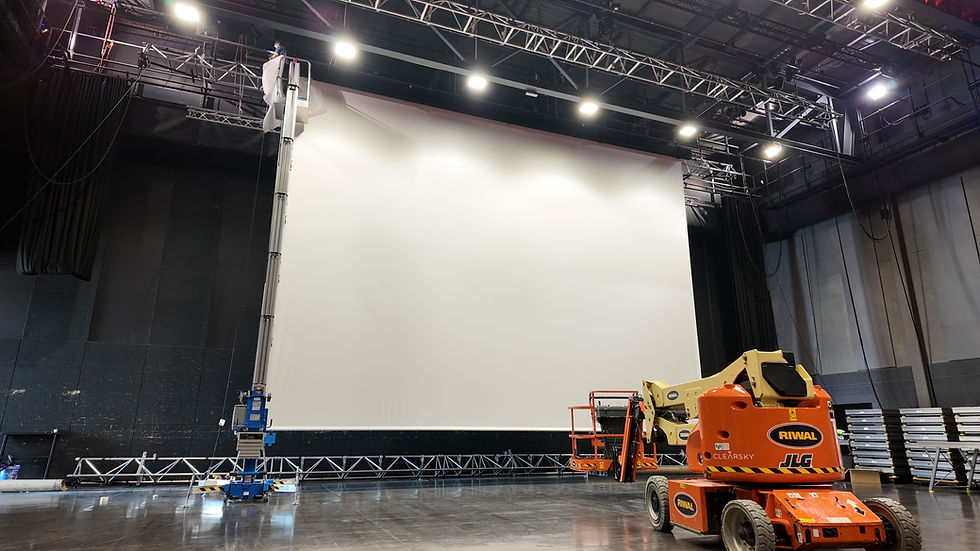
In a theater, auditorium, or cultural center, integrating a projection screen is not something that can be done on a whim. The stage configuration changes from one performance to the next. The screen must be able to appear in a matter of seconds and disappear just as quickly. This need for stage versatility necessitates precise technical choices right from the design phase.
Choosing a theater projection screen is not just about size or format. In 80% of stage projects, the chosen solution is a motorized roll-up screen. It deploys on demand, rolls up completely when not in use, and integrates seamlessly into often constrained architectural environments. The choice of system, mechanism, or screen depends on the dimensions of the venue, integration requirements, and budget. In listed buildings or with unusual geometries, a custom solution is often necessary.
What you will find in this article
Multivision installs projection screens in theaters, opera houses, cultural centers, and multipurpose venues in Belgium, Europe, and internationally. This article covers the specific constraints of this sector, the available systems, and the concrete criteria for choosing the right solution.
Why does one theatre impose constraints that other venues do not?
A meeting room or corporate auditorium has a predictable use. A theater does not. The same stage hosts a dance performance on Monday, a conference on Wednesday, and an opera on Friday. The screen must be there when needed, and invisible when not.
The number one constraint in this sector is reversibility . A fixed screen is out of the question in the vast majority of cases. Only theaters exclusively dedicated to projection can consider this option.
The screen must be as unobtrusive as it is powerful.
A screen that is visible when not in use clutters the stage and disrupts the scenography. The casing housing the mechanism must also be discreet, even invisible. In a historic theater or a listed building, this requirement becomes a strict architectural constraint subject to approval.
Acoustics: an often underestimated criterion
In a performance venue—opera house, concert hall, or musical theatre—acoustics are a priority. Installing a screen can interfere with existing acoustic solutions if it isn't carefully planned from the outset. The choice of fabric, the screen's position, and the design of its housing must be integrated from the initial project conception, not added as an afterthought.
How to choose a projection screen for a theatre or performance hall?
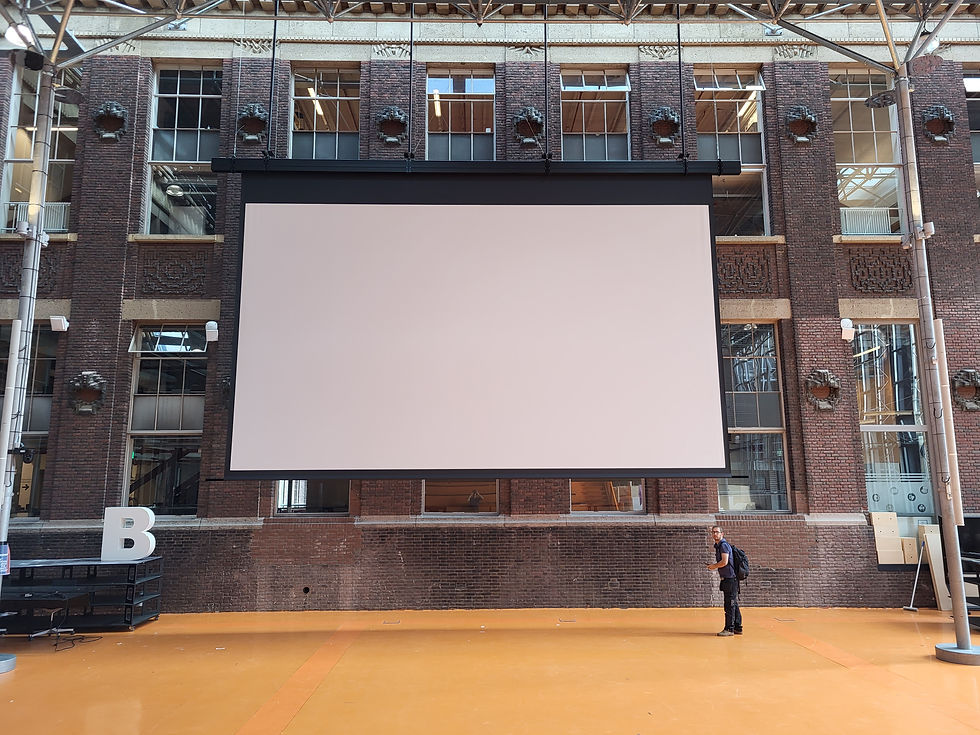
Before choosing a system, five questions to ask:
1. How often is the projection used?
If the screen is used occasionally, a lightweight and compact system will suffice. If the room is used for daily projections, the robustness of the mechanism becomes a priority.
2. Does the screen need to be invisible when not in use?
In a theatre, the answer is almost always yes. A motorized roll-up screen with an integrated housing is then one of the only viable options.
3. Are there any acoustic constraints?
If speakers are positioned behind the screen, a perforated or micro-perforated screen is needed to allow sound to pass through without attenuation.
4. Is the building listed or of strong architectural character?
In this case, the compactness of the housing and the discreetness of the mounting are criteria as important as the image quality.
5. What are the dimensions of the stage?
The screen width directly influences the choice of system. widevision screens are 4 to 7 meters wide, the nolimit covers a range of 7 to 100 meters. polivision from 7 to 25 meters.
polivision or nolimit: which large-format system should you choose for your room?
In the performance spaces, Multivision offers two motorized roll-up screen systems, each over 5m wide. Their mechanics differ, as do their advantages.
Mechanism | The winding tube wraps around the projection screen; once unwound, it is visible at the bottom of the screen. | The screen wraps around the winding tube which is placed directly in the screen housing, making it invisible. |
Dimensions | 7 to 25 m wide | 7 to 100 m wide |
Casing compactness | Standard | Very compact |
Weight | Heavier | Lighter |
Installation complexity | Large-scale complex | Simplified |
Cost | Higher | Smaller than equivalent dimensions |
When to choose it | Large installations, specific specifications | First intention in the majority of stage projects |
💡 Expert opinion
For most stage projects, Multivision recommends the nolimit as the first option. Lighter, more compact, less expensive, and developed in-house by our engineers. The polivision remains relevant for very large installations or when explicitly specified in the project requirements. The right question isn't "Which screen?" but "What are the actual constraints of my venue?"
The longevity of these systems can be verified in the field. In 2025, Multivision performed maintenance on a screen nolimit, installed over twenty years ago in Tubize, Belgium. Result: the mechanism is still fully functional after cleaning. Dust, humidity, and corrosion are the three enemies of a winding mechanism, three factors that can be controlled with annual maintenance.
When a standard screen is no longer enough: custom development
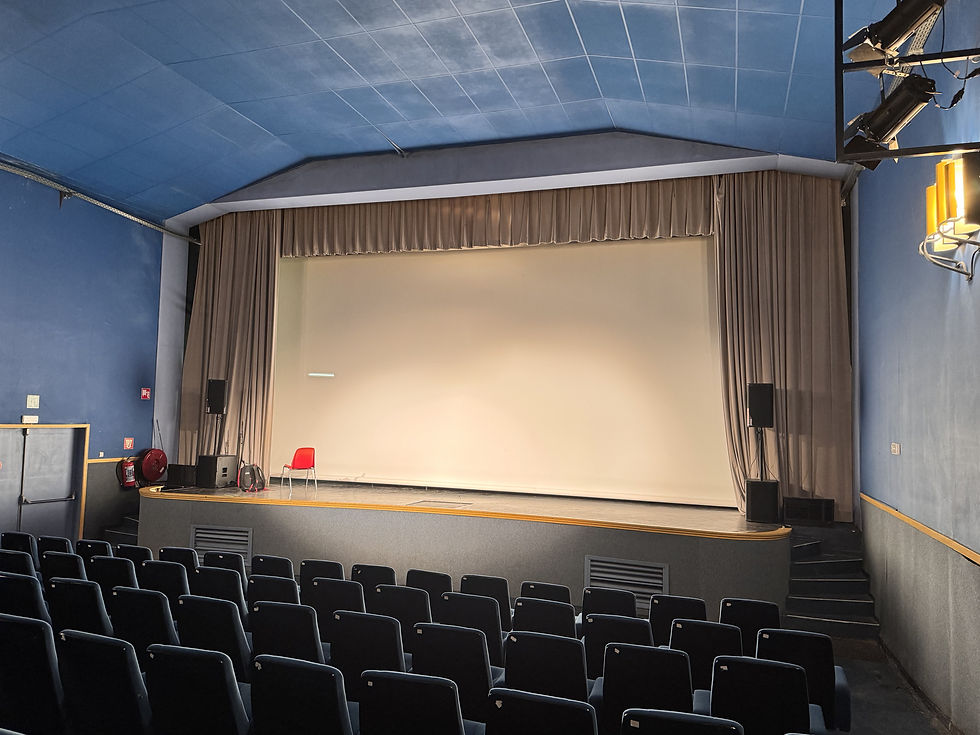
Some theaters have unusual geometries. Others are listed buildings subject to strict heritage constraints. In these cases, no off-the-shelf product precisely meets the project requirements.
This is where the Multivision's internal design office. Each custom project follows the same logic: starting with the actual constraints of the location before choosing a system.
When is a customized solution necessary?
Building listed or registered as heritage
Unusual stage geometry (thrust stage, modular hall, orchestra pit)
Standard housing too large for the available space
Unusual fastening constraints
Non-standard dimensions
💡 Expert opinion
A listed building is not an obstacle to the design. It is a design constraint like any other. The success of a project rarely depends solely on the technique, but much more on the method adopted. It is essential to begin by analyzing the site constraints before selecting a product, and to involve the engineering firm from the design phase rather than intervening too late.
Concrete case: the Uránia Theater in Budapest
In April 2023, Multivision installed a screen nolimit of 10 meters wide by 7 meters high in this listed Baroque theater, a cultural icon of Budapest. Strict integration constraints, heritage architecture, digital projection requirements.
The chosen fabric, Hi White micro-perforated, blends into the atmosphere of the space without altering its visual identity. Each technical choice was dictated as much by the constraints of the building as by the requirements of the image.
Concrete example: the New Century of Lille
In December 2020, Multivision installed two polivision screen in this leading cultural center located on Place de la République in Lille, measuring 16 meters long and 11 meters wide. The main hall can accommodate up to 1,475 spectators for concerts, operas, and international festivals.
Screens designed to last under heavy use conditions
A theatre puts far more strain on its equipment than a meeting room. The deployment and retraction cycles are repeated several times a week, sometimes several times a day, under real-world conditions and sometimes with mechanical constraints related to the stage installations.
Multivision manufactures its screens in Europe and assembles them in Belgium. The nolimit system is developed in-house, a solution designed and mastered by its own engineers. The result: direct control over the quality of materials and the durability of mechanisms.
Average lifespan: minimum 10 years. Often much longer.
For mechanics and engines: more than 15 years
For the projection screen: On average 10 years but this depends on its use and storage (always roll up the screen when not in use).
💡 Expert opinion
The question that operators rarely ask before purchasing is: what is the recommended maintenance frequency? A motorized retractable screen mechanism in a performance space should undergo at least an annual inspection, including cleaning the tracks, checking the motor, and verifying the screen tension. This isn't a burden; it's what extends a screen's lifespan from 10 to 20 years. The Tubize project in 2025 confirms this.
Multivision offers a dedicated maintenance service : cleaning of mechanisms, checking of motors, fabric tension control. An annual intervention is generally sufficient to prevent breakdowns and significantly extend the lifespan of the installation.
What specifiers expect from a stage screen manufacturer
Theatre projects involve several stakeholders with different expectations.
Profile | What he expects | What Multivision brings |
AV Integrator | Product reliability, deadlines met, precise specifications | Support from the design stage, installation support |
Design office | Technical dialogue on structure and acoustics | Early-stage involvement, in-house design office |
Architect / Set Designer | Discretion, visual integration, custom-made | Custom development, compact housing |
Technical Director | Ease of use, responsive customer service, reliable performance in the field | Maintenance and post-installation support |
A screen failure on opening night isn't a technical issue. It's a compromised performance. That's why the manufacturer's reliability and the quality of their after-sales service are just as important as the product's technical specifications.
Frequently asked questions about projection screens for theaters and performance venues
What type of projection screen should be installed in a theatre?
In a theater or performance hall, the motorized roll-up screen is the preferred solution in the vast majority of projects. The reason is practical: a stage hosts different artistic forms, often within the same week. The screen must be able to be deployed quickly for one performance and then completely retracted for the next. A dance performance doesn't require one. A conference or an opera may need a large one. This constant alternation necessitates a retractable solution. A fixed screen is only considered in very specific configurations where the stage is exclusively dedicated to projection.
What is the difference between a polyvision screen and a nolimit screen in a stage context?
These are two motorized winding systems with distinct mechanics.
In the In the Polivision system, the screen rolls up around a tube that descends with it: when the screen is deployed, the tube is visible at the bottom of the screen. This is the most historically popular, robust, and proven system, available in widths from 7 to 25 meters.
In the system Nolimit features a screen that rolls up into a fixed tube housed within the casing: the mechanism remains completely invisible. The casing is more compact, the screen lighter, installation simpler, and the cost lower for equivalent dimensions.
In a theatre where architectural discretion is a strong requirement, particularly in listed buildings, nolimit is generally the solution recommended by Multivision.
How to integrate a projection screen into a listed theatre or heritage building?
Integrating a screen into a listed building requires a tailored approach. Every intervention on this type of space is subject to strict heritage constraints: the casing must not distort the architecture, the fixings must be as unobtrusive as possible, and the dimensions of the screen must respect the proportions of the stage.
Multivision has a an in-house design office analyzes the specific constraints of each space before proposing a solution. The project was carried out at the Uránia Theatre in Budapest (a screen). nolimit (10 meters wide, integrated into a listed baroque environment) concretely illustrates this approach.
What is the lifespan of a projection screen in a performance hall?
A properly installed and regularly maintained Multivision screen has a lifespan of at least ten years. In reality, this lifespan is often much longer. In 2025, Multivision carried out the screen maintenance. The Nolimit system was installed over twenty years ago in Tubize, Belgium. The mechanism was still functioning. The main factors of degradation are dust, humidity, and corrosion, three factors that can be controlled with regular preventative maintenance.
Which projection screens are suitable for theatres and performance venues?
The choice of screen depends on the room's usage conditions. In most theaters, a matte white screen with neutral gain is suitable for standard projections. When speakers are positioned behind the screen, a perforated screen is necessary to allow sound to pass through. When the room hosts digital film screenings, a more technical screen may be required. To explore all the available fabrics, Multivision assists each project in choosing the appropriate surface.
Why use a specialist manufacturer rather than a general retailer?
A theatre is not a standard space. Its architectural, acoustic, and stage constraints are specific to each venue. A specialized manufacturer brings three things that a reseller cannot offer: the ability to design tailor-made solutions adapted to atypical configurations, the possibility of intervening from the design phase, and a long-term maintenance service.
Conclusion - Which screen is right for your stage space?
Here are some simple decision-making rules:
Choose the Nolimit if the venue requires a compact housing, a lightweight installation, and budget is a concern. This is the solution recommended by Multivision for the majority of stage projects.
Choose widevision if the screen dimensions are small (maximum 7m wide) and for a compact and lightweight solution.
Choose the polivision if the dimensions do not exceed 25 meters, or if the specifications explicitly state it.
Opt for custom-made solutions if the building is listed, if the geometry of the stage is atypical, or if no standard product meets the project's requirements.
Consult the engineering firm from the design phase, not at the end. This is what makes the difference between an installation that lasts and a project that accumulates adjustments.
Multivision supports AV integrators, design offices, architects, scenographers, and technical managers from the initial planning stages through to maintenance. This article draws on projects completed in theaters, opera houses, cultural centers, and multipurpose venues in Belgium and internationally.